

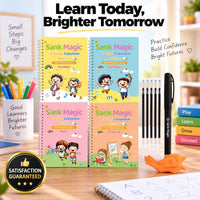



Quick answer. A busy board is a panel of real, safe mechanisms, things like latches, switches, zippers, and buckles, that a young child can open, turn, and fasten alone. It builds fine motor control, focus, and independence through hands on play, with no screen, and it works from around ten months into the preschool years.
Somewhere around the first birthday, most children discover a mission: open the thing, press the thing, unlatch the thing that grown ups keep closed. You see it at the kitchen cupboard, the seatbelt buckle, the light switch just out of reach. A busy board takes that exact drive and gives it a safe place to live.
If you have seen the term online and wondered whether it is a real learning tool or just a cute wooden gadget, this guide is for you. Here is what a busy board is, what it genuinely builds, and how to choose one that stays useful for years instead of a week.
What is a busy board?
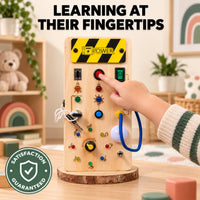
A busy board is a sturdy panel fitted with functional parts a child can operate: latches and locks, light switches, spinning gears, zippers, buckles, laces, knobs, and doors that open to reveal something behind them. The key word is functional. These are not pictures of a zipper. They are the real mechanisms, sized and mounted so small hands can work them without the risks of the real cupboard or the real front door.
The idea grew out of Montessori practical life work, where children build coordination and confidence by doing real tasks with real objects. A busy board simply gathers a set of those tasks onto one surface your child can reach.

Shop this
What it teaches, beyond keeping hands busy
It is easy to see a busy board as a distraction. What it is really doing is quieter and more important.
Fine motor control. Turning a knob, pinching a zipper pull, and threading a lace all strengthen the small muscles of the hand and the pincer grasp. Those are the same muscles a child will later use to hold a crayon and then a pencil. The pincer grasp typically develops across the first year, and it grows stronger with exactly this kind of practice.
Focus and persistence. A latch that does not open on the first try invites a second try. A child working a stubborn buckle is practicing sustained attention and the willingness to stay with something difficult, which matters far more for later learning than any single skill.
Cause and effect. Flip the switch, the light changes. Turn the gear, the next one moves. Young children are natural scientists, and a busy board answers the question they ask all day: what happens if I do this?
Real independence. The buckle on the board is the same buckle on the car seat. The zipper on the board is the zipper on the coat. Practice on the board quietly transfers to dressing, which is one of the first places a toddler gets to feel genuinely capable.
How to choose one that lasts
Not all busy boards are equal, and the difference shows up around week three, when a poorly chosen one is abandoned. Use this checklist.
| What to look for | Why it matters |
|---|---|
| A range of difficulty | Easy parts for now, harder parts for later, so the board grows with your child instead of being outgrown |
| Genuinely secure parts | Everything firmly fastened, no small pieces that pull free, smooth edges |
| Real mechanisms, not decoration | Working latches and buckles build skills; painted on shapes do not |
| Solid materials | Wood and quality fittings survive daily toddler use; flimsy plastic does not |
| A size that fits your life | A portable board travels; a large one stays a home base. Pick for how you will use it |
| No screen, no batteries | The child supplies the action and the interest, which is the whole point |
A rough guide by age
Around ten to eighteen months: simplest actions win. Switches, big knobs, doors that open. Success on the first try builds the confidence to keep exploring.
Eighteen months to three years: this is the sweet spot. Latches, zippers, buckles, and laces all become possible, and this is where a busy board earns hours of independent play.
Three to six years: the harder fastenings and any counting, matching, or sequencing elements come into their own, and the board becomes a self care trainer as much as a toy.
This is also why a board with a spread of difficulty is worth more than a simple one. It meets your child where they are today and still has something to offer a year from now.
Frequently asked questions
What age is a busy board for?
Most children get real use from around ten months, when the drive to open and press takes hold, through the preschool years. A board with easy and hard elements covers the widest span.
Are busy boards Montessori?
They grow directly from Montessori practical life ideas: real tasks, real objects, and the independence that comes from doing things yourself. Many families use them as part of a Montessori style setup at home.
Do busy boards actually help development, or are they just entertaining?
Both. The entertainment is what keeps a child engaged, and the engagement is what builds the fine motor control, focus, and independence underneath it.
Busy board or busy book?
A board suits home play and stays put; a book folds flat and travels. Many families keep one of each for different moments.
Bright Bloomer builds screen free busy boards with a deliberate spread of easy and challenging parts, so the board your child loves at one still has something to teach at three. If a busy board is on your list, look first for that range of difficulty, then for solid, secure construction. Those two things separate a board that lasts from one that gathers dust.