

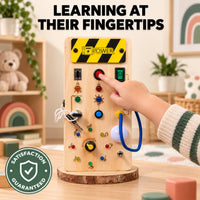





Quick answer. A toddler attention span is short by design. Young children focus for only a few minutes on an adult chosen task, and that is developmentally normal, not a problem to fix. Focus grows slowly with age and, importantly, with practice. Open ended, hands on play that a child chooses builds sustained attention, while fast, constantly changing screen content can make quiet focus feel harder by comparison.
Few things worry parents quite like watching a toddler flit from toy to toy, abandoning each after a minute, and wondering whether something is wrong with their ability to concentrate. So let us start with the reassurance: almost certainly, nothing is wrong. A short attention span is one of the defining features of being a toddler.
Understanding what is normal, and how attention actually grows, takes the worry out of it and points to the small things that genuinely help.
What is normal for a toddler attention span
Attention varies enormously from child to child and from moment to moment, so treat any number as a loose guide rather than a rule. In general, a young child can sustain focus on a task an adult has chosen for only a short time, often just a few minutes, and their attention on something they have chosen themselves tends to last considerably longer.
Two patterns are worth knowing.
First, self chosen play holds a toddler far longer than adult directed activity. The same child who lasts two minutes at a worksheet you set may play at a busy board of their own choosing for twenty. This is not inconsistency. Interest and ownership are fuel for attention.
Second, focus is not fixed. It grows with age, and it grows with practice. A child who regularly has the chance to become absorbed in play is building the very capacity to concentrate that they will later need for school.

Shop this
What helps focus, and what quietly works against it
You cannot force a toddler to concentrate, but you can shape the conditions that let focus grow. The differences are simple and they add up.
| Helps focus grow | Works against it |
|---|---|
| Open ended toys a child can stay with and direct themselves | Toys that perform for the child and end the play quickly |
| Letting an absorbed child continue without interruption | Breaking in to praise, redirect, or offer the next thing |
| A calm space with only a few toys out at once | A cluttered field of many toys, which scatters attention |
| Slow, hands on activities with no fixed ending | Fast, constantly changing screen content as the default |
| Enough sleep, food, and movement | A tired, hungry, or cooped up child, who cannot focus on anything |
That fourth row deserves a word. Fast paced media is not the same experience as quiet play. When a screen delivers a new image every second, quieter activities can feel dull by comparison for a while afterward. This does not mean screens ruin attention, but it does mean a steady diet of high speed content sits alongside, and can crowd out, the slow absorbed play that builds focus. Protecting time for that slow play is the point.
The simplest way to build focus: protect deep play
Here is a small habit with an outsized effect. When you notice your toddler genuinely absorbed in something, resist the urge to interrupt. Do not swoop in to praise, to photograph it, or to suggest a better way. Let the moment run.
Those stretches of deep, uninterrupted play are attention being built in real time. Every time a child follows their own focus all the way to its natural end, the muscle of concentration gets a little stronger. Your job is often simply to guard the quiet and stay out of the way.
Frequently asked questions
What is a normal attention span for a toddler?
Short. A young child typically focuses on an adult chosen task for only a few minutes, though they often stay much longer with play they have chosen themselves. Wide variation between children is completely normal.
How can I improve my toddler's focus?
Offer open ended, hands on toys they can direct, keep only a few out at once, avoid interrupting absorbed play, and make sure they are rested, fed, and have had a chance to move. Protecting slow play matters more than any single toy.
Does screen time shorten a toddler's attention span?
The evidence is mixed and complicated. What is clearer is that a heavy diet of fast, constantly changing content can make quieter play feel less engaging by comparison, which is a reason to protect time for slow, hands on play.
When should I be concerned about my child's attention?
If you have genuine, ongoing worries about your child's focus, development, or behavior, your pediatrician is the right person to talk to. Asking is always reasonable and often reassuring.
Bright Bloomer designs open ended, hands on toys with no fixed ending, the kind of play a child can sink into and direct, precisely because that absorbed play is where focus is built. The most powerful tool, though, costs nothing: when your toddler is deep in play, leave them to it.