

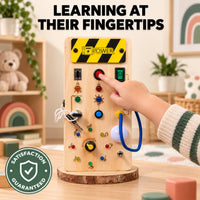





Quick answer. What to do with a bored toddler is often less than you think. A short stretch of boredom is not harmful; it is the pause from which a child's own ideas and play emerge. Rather than rushing to entertain, give it a moment, then offer a simple open ended invitation, like a basket of blocks or a busy board, and let your child take it from there.
The words land somewhere between a whine and an accusation: "I'm bored." Or, from a younger toddler, the wordless version, trailing you around the house, poking at things, clearly at a loose end. The instinct is to leap in and fix it, to suggest, to set up, to hand over a screen. Before you do, it is worth knowing what boredom is actually doing.
Why a little boredom is good
Boredom feels uncomfortable, and that discomfort is the point. It is the gap between having nothing to do and finding something to do, and it is in that gap that a child reaches for their own ideas.
A toddler who is always entertained, always given the next activity, rarely has to generate play from scratch. A toddler who is occasionally left with a little boredom learns to look around, notice what is available, and invent something. That is the root of independent play and of creativity: the ability to make your own fun.
So the goal is not to prevent boredom. It is to let a short stretch of it do its work, and then to make sure the environment offers something worth reaching for.

Shop this
What to do with a bored toddler, instead of rescuing
You do not have to fill every empty moment, and you also do not have to leave a toddler adrift for an hour. There is a middle path.
- Pause before you rush in. When your child says they are bored, resist fixing it for a beat. Often, given a minute, they find their own next thing. That moment of resistance is where their idea gets born.
- Offer an invitation, not a full program. Rather than directing the play, set out a simple, open ended prompt: a basket of blocks on the rug, a busy board within reach, some cushions to climb. Then step back. An invitation sparks; it does not script.
- Resist becoming the entertainment. If you always become the activity, your child learns to depend on you for fun. Being nearby is different from running the show.
- Keep the environment ready. Boredom only turns into play if there is something to reach for. A small, rotating set of open ended toys the child can access themselves does most of the work.
Set the stage so boredom turns into play
The difference between fruitful boredom and a spiralling meltdown is usually the environment.
| Helps boredom become play | Keeps a child stuck |
|---|---|
| A few open ended toys within easy reach | A screen as the default rescue |
| A small, rotating selection so things feel fresh | A mountain of toys that overwhelms |
| Open ended materials that invite ideas | Toys that do one fixed thing and end |
| Your calm presence nearby | An adult who jumps in and takes over |
Notice that none of this requires you to be the activities director. It requires a ready environment and the willingness to let a short, useful boredom breathe.
Frequently asked questions
What should I do when my toddler is bored?
Pause before rushing in, then offer a simple open ended invitation like blocks or a busy board and step back. A short stretch of boredom often turns into your child's own play.
Is boredom bad for toddlers?
No. A little boredom is healthy. It is the pause from which children generate their own ideas, which builds creativity and independent play. The aim is not to prevent it but to keep the environment ready.
How do I get my toddler to play independently instead of being bored?
Keep a small, rotating set of open ended toys within reach, offer invitations rather than running the play, and avoid being the default entertainment. Let short boredom do its work.
Should I let my bored toddler watch a screen?
An occasional screen is fine, but if it is always the rescue for boredom, a child never learns to make their own fun. Try an open ended invitation first.
Bright Bloomer designs open ended toys, busy boards, busy books, building sets, precisely because they are the kind of thing a bored child can reach for and turn into their own play. The most useful move, though, is often to do less: pause, offer a simple invitation, and let your toddler discover what to do next.