




Quick answer. To teach a toddler to zip and button, practice the skills through play before expecting them on real clothes. Dressing develops in an order: children undress before they dress, manage large fastenings before small ones, and need strong, precise hands first. Fastening toys, dressing dolls, and busy boards let a child practice buttons, zips, and buckles calmly, with no rush to get out the door.
Getting dressed looks simple until you watch a two year old try. A zipper that will not catch, a button that will not push through, a shirt that ends up on backward and inside out. Dressing is one of the first big independence projects of childhood, and like all of them, it is learned in stages and best practiced through play, not in the frantic rush before you leave the house.
Here is how these skills actually develop, and how to help them along without the morning battle.
The order dressing skills develop in
Self care follows a predictable path. Knowing it takes the pressure off and tells you what to encourage now.
- Undressing comes before dressing. Pulling off a sock, a hat, or shoes is far easier than putting them on, and children master it first. A toddler who strips off in the living room is practicing, not misbehaving.
- Big fastenings before small ones. Large buttons, chunky zips, and simple buckles come before fiddly small buttons and delicate zips. Strength and gross control arrive before fine precision.
- Pulling before manipulating. Pulling up trousers with an elastic waist or pushing arms through sleeves comes before the precise finger work of doing up a button.
- Finally, the precise fastenings. Small buttons and starting a zipper on real clothes are among the last to click, often into the preschool years, because they need the most refined hand control. Tying shoelaces usually comes later still, around the early school years.
Children vary widely in when they reach each stage, so treat this as an order, not a timetable. If you have real concerns about your child's hand skills or development, your pediatrician is the right person to ask.

Shop this
Why play is the best practice ground
Real clothes, on a real morning, are the hardest place to learn. The child is often tired or rushed, the stakes feel high, and everyone is watching the clock. Play removes all of that. Practicing a button on a toy, with no deadline and no pressure, lets a child work the skill calmly and repeat it as many times as they like.
Practice on a toy transfers, because a button is a button. The fastening on the busy board is the same movement as the fastening on the coat.
Playful ways to practice buttons, zips, and buckles
- Fastening toys and dressing frames. Boards and frames with a single fastening to practice, a zip, a row of buttons, a buckle, let a child focus on one skill at a time.
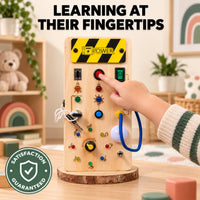
- A busy board. A busy board gathers many fastenings onto one surface, so buttons, zips, buckles, and laces all get practiced in one absorbing activity a child returns to on their own.
- Dressing dolls and soft toys. Doing up a doll's coat or a teddy's buttons is motivating pretend play that happens to be pure dressing practice.
- Dress up play. A basket of hats, bags, and simple costumes turns putting clothes on and taking them off into a game.
- Real clothes, on your schedule. When there is no rush, let your child do up their own coat or pull on their own trousers, and build in extra time so trying is possible.
Make real dressing easier while they learn
A few small changes help enormously. Choose clothes with large buttons, elastic waists, and easy zips while skills are developing. Lay clothes out so the child can see which way they go. And add time, since a rushed toddler cannot practice. Ten unhurried minutes teaches more than a frantic thirty seconds.
Self care skills and playful ways to practice
Every fastening on a toy is the same movement as the one on real clothes, so play transfers.
| Self care skill | Practice it through play |
|---|---|
| Buttoning | A button page or busy board, dressing a doll |
| Zipping | A zip on a busy board, then a coat with no rush |
| Buckling | A buckle toy, the same clip as a car seat |
| Pouring and wiping | A small jug and cloth at a low table |
| Putting on shoes | Practice on a doll first, then real shoes with time |
Frequently asked questions
How do I teach my toddler to zip and button?
Practice through play first, using fastening toys, dressing dolls, and busy boards, where the same buttons and zips can be worked calmly and repeatedly. Then let them try on real clothes when there is no rush.
At what age can a toddler dress themselves?
It varies, but children generally undress before they dress, manage large fastenings before small ones, and master precise fastenings like small buttons and zips into the preschool years. Treat it as an order rather than a fixed timetable.
What toys help with dressing skills?
Fastening toys and dressing frames, busy boards with buttons and zips, dressing dolls, and dress up baskets all let a child practice self care through play.
Why does my toddler undress but not get dressed?
Undressing is simply easier and develops first. Pulling off a sock takes far less control than putting it on, so children master taking clothes off well before putting them on.
Bright Bloomer busy boards bring buttons, zips, buckles, and laces together in one activity, so a child can practice the movements of getting dressed through play they choose themselves. However you practice, the recipe is the same: work the skills calmly on toys first, choose easy clothes while they learn, and give real dressing the unhurried time it needs.